Looking to add a steady, income-focused property to your LA portfolio without straying far from core job centers? Glendale’s small multifamily market gives you a practical path to cash flow with room to grow through smart upgrades and ADUs. If you want clear rules, realistic underwriting notes, and a playbook for value, you are in the right place. In this guide, you will learn what to buy, which local regulations matter most, how ADUs can change your numbers, and where financing and exit strategies fit in. Let’s dive in.
Glendale at a glance
Glendale is a job-rich city in LA County with an estimated population of about 187,800 and an owner-occupied rate near 35 percent, which points to a large renter base that supports small multifamily demand. You can confirm these figures in the U.S. Census QuickFacts for Glendale. Review the latest Census snapshot for Glendale.
You benefit from proximity to regional employment hubs like the Glendale Galleria and the Americana at Brand retail centers, healthcare, and nearby studio and animation jobs, with Burbank’s media employment close by. For general context, see the Glendale city overview.
Current listings suggest that small to mid-sized Glendale apartment properties often market at cap rates in the mid 4 to low 5 percent range. Use active listings as a directional check and confirm with a curated comp set. You can browse recent Glendale multifamily listings.
Glendale tends to act as a defensive, core-plus hold within the 101 and 134 corridors. Regional market conditions still matter, so keep an eye on metro-wide rent and vacancy trends. For broader LA multifamily context, see CBRE’s multifamily research hub.
What you can buy in Glendale
Typical buildings and eras
You will find many older courtyard and garden-style properties from the 1920s through the 1970s, plus mid-century walk-ups and occasional newer infill of 2 to 8 units. The city’s planning and housing documents note that a large share of Glendale’s multifamily stock is older vintage. For planning context, scan the Glendale Housing Element.
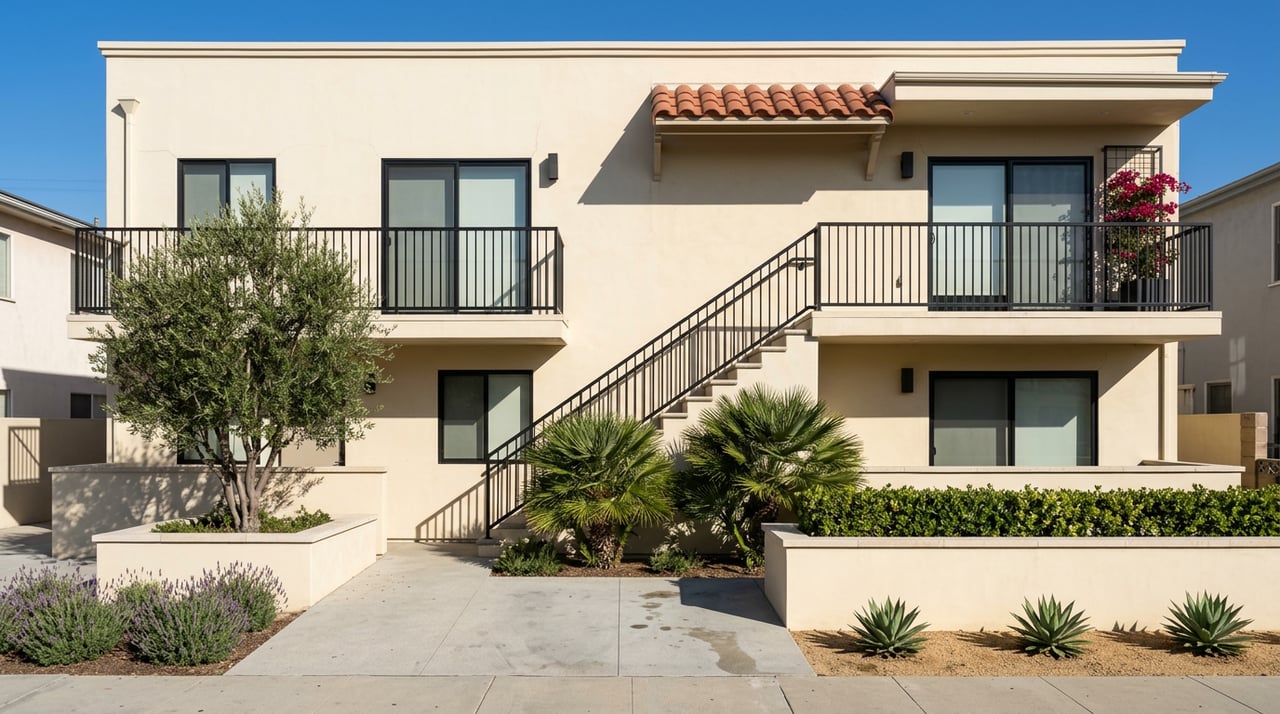
Duplexes and 2 to 4 unit properties are common entry points for local investors. Fourplexes arranged around a central garden or parking court show up frequently, and mid-century walk-ups are common throughout.
Common floor plans and mixes
You typically underwrite studios, 1-bedrooms, and 2-bedrooms in garden walk-ups. Duplexes often present as an upstairs and downstairs split with one and two bedrooms. Fourplexes often show 2×1-bedroom plus 2×2-bedroom mixes or four 1-bedrooms in classic owner-user formats.
Investor takeaway: light interior updates and operational fixes often unlock outsized rent uplift in older buildings, as long as you plan around Glendale’s tenant protection rules. Focus on modernized kitchens and baths, laundry, and clear parking policies. Verify feasibility for separate utility metering and document any code-triggered upgrades before you budget.
Rules that impact your returns
Glendale’s Rental Rights Program
Glendale’s local Rental Rights Program adds important protections on top of state law. Key points include: a required offer of a one-year written lease to new tenants, just-cause eviction standards, and a relocation assistance trigger when a rent increase exceeds 7 percent in a 12-month period. The municipal code outlines enforcement and penalties. Read the Glendale Municipal Code, Chapter 9.30 and scan the city’s Rental Rights resources.
What it means for you: rapid raise to market plans can get expensive. Many investors choose phased rent normalization at natural turnover. If your strategy depends on quick rent steps, budget relocation assistance or buyouts, plan for one-year lease structures, and assume longer re-rent timelines.
State-level rules: AB 1482
California’s Tenant Protection Act, AB 1482, caps many covered rent increases at 5 percent plus regional CPI, not to exceed 10 percent, and provides just-cause protections statewide. Glendale’s local program layers additional lease and relocation rules. For a clear summary, review the AB 1482 overview.
Underwriting tips for compliance
- Verify whether each unit is covered by AB 1482 and subject to Glendale’s local rules.
- Model conservative turnover timing and a slower rent recovery path.
- Include a relocation or negotiated buyout allowance for a subset of units in value-add scenarios.
- Keep organized rent histories and lease files. Buyers will ask for them later.
ADUs as a growth lever
What state law now allows on multifamily lots
Recent state updates give multifamily owners more options. Under SB 1211 and HCD’s 2025 ADU Handbook, cities must allow up to eight detached ADUs on a lot with an existing multifamily building, limited to not more than the number of existing units. Cities must also allow conversions of non-livable portions of existing multifamily structures to ADUs, up to specified limits such as 25 percent of the existing unit count. Read the HCD ADU resources and the SB 1211 bill text.
What it means for you: surface parking areas, basements, and storage rooms can become real unit count and income when site constraints and objective standards are met.
Glendale’s permitting and local standards
Glendale actively publishes ADU guidance and supports ministerial review under state rules. Site design, heights, setbacks, utilities, and objective design standards still apply, along with Glendale Water & Power review and covenant requirements. Start with a planning counter screening to avoid surprises. Begin here: Glendale Planning ADU portal.
Quick ADU feasibility screen
- Lot layout: Identify areas for detached ADUs and any non-livable spaces that could convert.
- Fire and utilities: Check clearances, service capacity, and access for Glendale Water & Power.
- Objective standards: Confirm heights, setbacks, parking, and privacy rules.
- Timeline and fees: Ask Planning for a ministerial checklist, target review windows, and fee schedule.
- Rent comps: Compare projected ADU rent to hard costs and carry.
Value-add plays that work in Glendale
- Cosmetic unit rehabs at turnover. Modernize kitchens, baths, lighting, and flooring as leases roll. This avoids Glendale’s relocation trigger that can be hit by larger mid-lease increases. See local rules in the Rental Rights code.
- Operational lift. Add or formalize laundry, clarify parking with permit signage, and consider utility submetering where feasible. These changes often boost net income without major entitlement.
- ADU-driven upside. Detached ADUs and conversion ADUs can raise unit count and blended yield. Use the HCD handbook and secure a Glendale pre-screen before design spend. Confirm SB 1211 allowances.
- Legalize informal units. If present, consult city building staff early. Upgrades or life-safety improvements may be required. For context, see the city’s Housing Element.
Financing basics for 2 to 4 units
Two to four unit properties can qualify for residential loans or investor programs, depending on occupancy and borrower profile. Owner-occupants may use conventional or FHA. Non-owner investors often use DSCR products that size the loan to the property’s income. Terms and lender pools change, so consult a mortgage broker. For a practical overview, see this DSCR loan guide for small multifamily.
Tips:
- Match loan type to your plan. If you plan to live in a duplex, owner-occupied financing can lower your down payment. If you are buying a fourplex to hold, a DSCR product can be more flexible.
- Budget reserves and improvements. Many lenders require higher reserves for investment property and will ask about property condition.
- Know your rent roll. Lenders will scrutinize in-place rents and lease terms, especially in Glendale where local rules affect rent growth pacing.
Exit strategy and buyer pool
Expect a buyer pool of local and regional mom-and-pop investors, 1031 buyers, and small private investors. Institutional buyers rarely chase 1 to 8 unit assets. Glendale’s relocation and lease rules can narrow the most aggressive value-add buyers, so clear documentation and a compliance-forward story help when you sell.
Position the asset as a stable core-plus hold. Highlight location benefits, in-place income relative to market, any permitted or shovel-ready ADU potential, and a documented capital plan that respects Glendale’s tenant protections. Include clean rent ledgers and written notes on relocation exposure that you have already modeled.
A simple 90-day plan to get started
- Days 1 to 30: Define your buy box. Pick sub-neighborhoods, unit count, parking needs, target cap rate band, and a realistic rent timeline that fits Glendale’s rules. Start underwriting live deals and track a comp log from MLS and LoopNet.
- Days 31 to 60: Run site screens. For top candidates, complete a light ADU feasibility review using HCD guidance and a Glendale Planning pre-screen. Price cosmetic turns and basic operational lifts.
- Days 61 to 90: Lock financing and offer. Align a loan product with your plan, set a relocation or buyout reserve if needed, and write offers with enough diligence time for code and ADU checks. Prepare your property management and leasing plan in advance.
Ready to find and underwrite the right Glendale duplex, fourplex, or small garden complex? Connect with Andy Hairabedian for local deal flow, ADU screening, and a clear acquisition plan tailored to your goals.
FAQs
How do Glendale’s tenant rules affect rent increases after I buy?
- Glendale’s Rental Rights Program requires offering a one-year lease to new tenants and triggers relocation assistance if a rent increase exceeds 7 percent in 12 months, on top of state AB 1482 limits. Review the local code and the AB 1482 overview.
Are ADUs feasible for small multifamily in Glendale?
- Often yes. SB 1211 and the HCD ADU Handbook expand detached and conversion ADU options on multifamily lots, subject to site limits and objective standards. Start with the HCD ADU resources and a Glendale Planning ADU pre-screen.
What cap rates should I expect for Glendale small multifamily?
- Recent listings suggest mid 4 to low 5 percent cap rates for marketed small to mid-sized assets in Glendale. Use a curated 90-day comp set to confirm. Browse current Glendale listings.
How should I underwrite a Glendale fourplex to be conservative?
- Model slower re-rent timing to avoid Glendale’s relocation trigger, include a relocation or buyout allowance for some units, and run scenarios with and without ADU upside. Keep comps current using MLS and LoopNet.
Who typically buys when I sell a 2 to 8 unit Glendale property?
- Expect local and regional mom-and-pop investors, 1031 buyers, and small private investors. Institutional capital rarely targets this size band, so thorough documentation and a compliance-forward story help your exit.